The complete learning bundle
Both PDFs, runnable OpenFOAM templates, analysis scripts, all eight mesh measurements, captions, sources and integrity checks.
Download learning files 1.0 ↓No sign-up. No software installer. Start with N10 and N20.
 CFD FIELD NOTESCarsten Püttbach
01 / LID-DRIVEN CAVITY · OPENFOAM
Learn to ask what your CFD calculation actually tells you — with eight meshes, visible comparisons and a checkable trail.
THE QUESTION THAT GUIDES THE LESSON
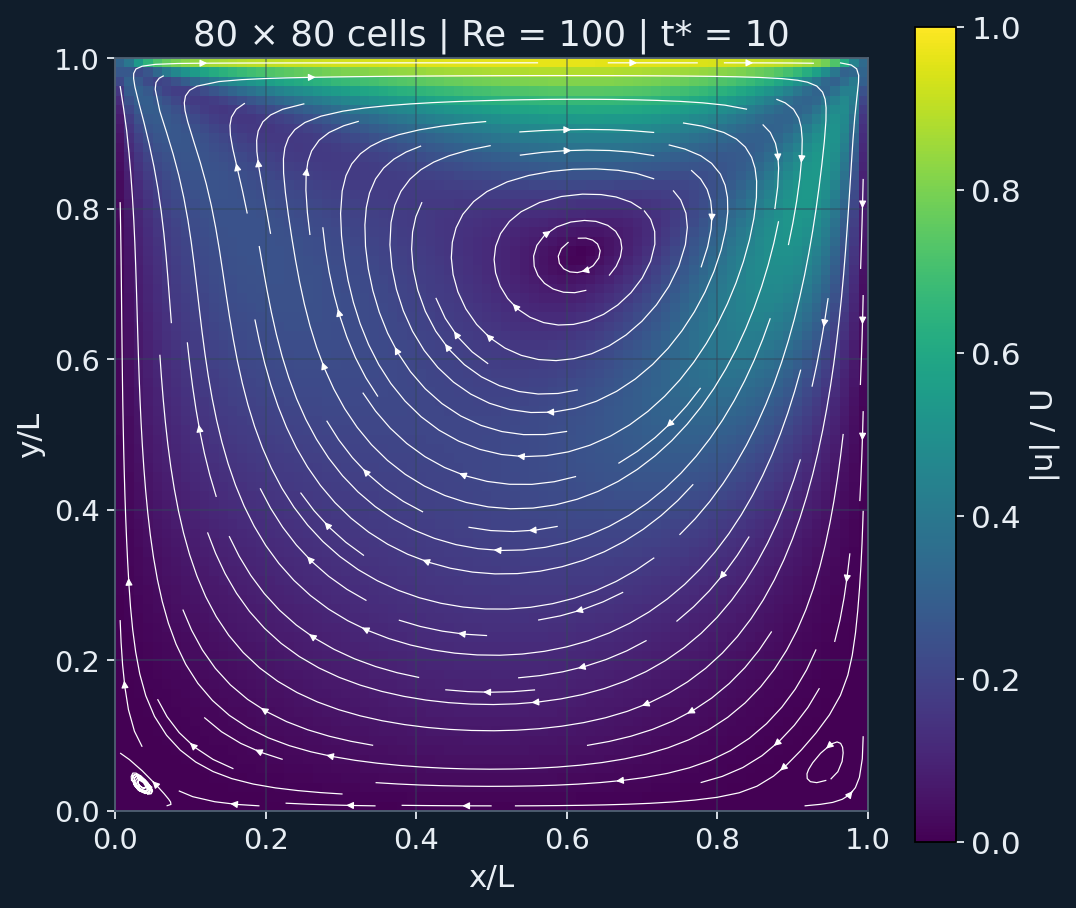
We measure the same horizontal-velocity probe on every grid. A stable-looking vortex centre does not guarantee that every other quantity has settled.
EIGHT MESHES. ONE PHYSICAL LOCATION.
The probe is at x/L = 0.5, y/L = 0.75. N is the number of cells along each side; the 2D mesh contains N × N cells and one empty spanwise cell.
These are finite-time measurements at Re = 100 and t = 1 s. Differences from the finest available grid are sensitivity measures, not exact errors.
Download the plotted measurements (CSV) ↓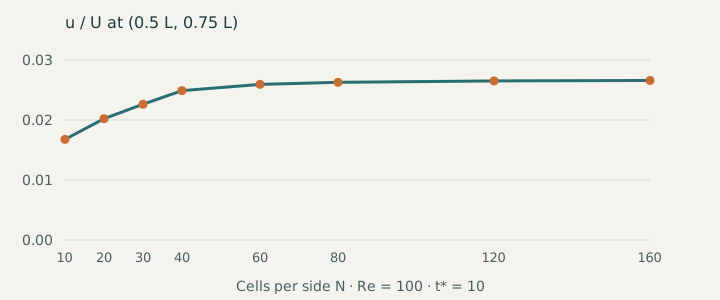
LEARN AT YOUR OWN PACE
Learning release 1.0 accompanies film v0.7.
The retained PDFs keep their original version numbers.
Both PDFs, runnable OpenFOAM templates, analysis scripts, all eight mesh measurements, captions, sources and integrity checks.
Download learning files 1.0 ↓No sign-up. No software installer. Start with N10 and N20.
Physical model, case setup, mesh comparison, numerical references and the evidence behind the lesson.
Read the workbook ↗Equation terms, moving profiles, continuity, the curvature operator and the matched-Re water example.
Read the visual notes ↗YOUR FIRST REPRODUCTION
Use the current quick start for commands. The original workbook uses a generic Python command; on the production Mac, analysis uses the system interpreter with NumPy.
Target: the native OpenCFD v2606 Mac application. Other OpenFOAM versions need checking. Nothing in this download installs packages or replaces existing runs.
zsh run_on_mac.sh
/usr/bin/python3 analyse_demo.py
The first command computes new N10/N20 cases. The second measures the same probe in both results. New runs have their own timestamped directories.
Read prerequisites and all experiment commands ↗WHAT THIS EPISODE DOES — AND DOES NOT — ESTABLISH
Mesh response, a matched time-step check, a settling screen and comparisons with independent numerical references.
Laminar, incompressible, constant-property flow. The water example illustrates dimensionless similarity; it is not a thermal or phase-change model.
Sources accompany the film and the learning material. Numerical reference agreement is not experimental validation or a formal ASME conformity claim.
START WITH THE PRIMARY TRAIL
THE NEXT INVESTIGATION
NACA 0012 is in preparation: exact geometry, angle of attack, surface pressure and aerodynamic forces. No uncomputed results are promised here.
Follow CFD Field Notes ↗Where did an explanation click — and where did you need another step?
Leave your feedback under the episode.